
THE
GUARDIAN 27 FEBRUARY 2020 - Persimmon chief quits amid row over firm's building quality
Dave Jenkinson only took over 15 months ago after bonus backlash for predecessor
Persimmon has announced the departure of its chief executive as the housebuilder scrambles to improve the quality of its homes following a damning independent review and a deluge of customer complaints.
The departure of Dave Jenkinson was revealed only 15 months after he took over in the wake of a backlash against his predecessor’s £75m bonus. He is leaving despite the business posting a profit of more than £1bn for the second year in a row on Thursday.
Persimmon reported a pre-tax profit of £1.04bn for 2019, down slightly from the previous year’s £1.09bn, which was the biggest annual profit ever made by a UK housebuilder. It banked a profit of £65,657 on every house sold, compared with £66,326 in 2018.
Jenkinson, previously the managing director of the York-based business, has spent 23 years at the company and has informed the board of his wish to step down “in due course”, Persimmon said. He may remain at the helm for a few more months while the firm looks for a successor.
Julie Palmer, a partner at the corporate restructuring consultancy Begbies Traynor, said: “Persimmon’s financials may be on a solid base currently but the company’s reputation is continuing to show cracks as reports of customer complaints are rife for the housebuilder, with concerns around its build quality.
“This has ultimately led to Dave Jenkinson’s departure and his replacement will need to rebuild the company’s image.”
In December, an independent review commissioned by the firm found a “systemic nationwide failure” to install fire-stopping cavity barriers in its timber-frame houses that left customers exposed to an “intolerable” fire risk. The report also said the failure to meet minimum building standards was “a manifestation of poor culture” at the firm.
In response, Persimmon is carrying out a review into its “purpose and culture” and will report on it at its annual meeting in April. It has also appointed a new construction champion to oversee construction processes and standards centrally.
The company has inspected more than 20,000 of its properties, found a third had insufficient fire protection and fixed them. Inspections continue and will involve tens of thousands more homes – about a third of the houses Persimmon builds every year are
timber frame. It is not paying out any compensation to customers in relation to the issue.
Persimmon sold 15,855 houses last year, down 4% on 2018 after it slowed down the build process to improve quality. Problems with poor workmanship extended to the upmarket
Charles Church brand owned by Persimmon. However, the average selling price rose to £215,709 from £215,563.
The scandal over fire risks and general build quality comes after a hugely damaging pay row. Jenkinson’s predecessor, Jeff Fairburn, then the UK’s highest-paid chief executive, was ousted in November 2018. His £75m bonus in 2018 was attacked as “obscene” by politicians, charities and corporate governance experts – in particular because Persimmon has been one of the biggest beneficiaries of the government’s help-to-buy programme, which will run until 2023. The scheme accounted for 43% of the firm’s sales last year. Jenkinson also received £45m in pay and bonuses in 2017 and 2018. The payments were part of a £444m pay bonanza for the firm’s most senior bosses. Persimmon says there won’t be any more payouts under that share bonus scheme, which dates back to 2012.
Jenkinson said: “I’m very pleased with the progress that we’ve made over the last year in reshaping Persimmon’s approach and culture while at the same time maintaining our operational momentum.”
He insisted that the build improvement programme was on track. “[The changes] are embedding, they are working, we are seeing tons of improvements. The reason I’m leaving is because the business is in such a good process.”
Shares in Persimmon were down 5.5% at £29.08 by midday on Thursday, valuing the company at £9.4bn.
NOTE:
There is a delicate balance between high quality builds and lesser class,
the lower quality build yields higher profits, while the house prices
appear more attractive to customers. But then discover that what looks
to be a bargain, is actually at the expense of profits.
£65,657 in 2020 is equivalent in purchasing power to about £83,673.34 in
2026.
This represents a cumulative increase of 27.43% in the cost of a typical basket of goods and services. But this is dependent on house price fluctuations.
In nominal terms, average new build house prices have risen from roughly $316,000 (£242,000) in 2020 to around $475,000 to $515,000 (£360,000 to £395,000) by 2026. However, once adjusted for the severe inflation seen over the same period, real-term price increases are modest.
The housing market over this six-year period underwent several distinct phases: the 2020/2021 Covid-induced boom, a 2023 market dip driven by elevated mortgage rates, and a period of stabilization and modest recovery.
Here is how the new build market of 2020 compares to today's market:
1. Headline Prices
2020 Averages: The average price for a newly built home in the UK sat around the £240,000 to £250,000 mark.2026 Averages: The average price of new builds has climbed considerably.
According to GOV.UK UK House Price Index data, average new build prices sit around £362,000 to £393,000, heavily dependent on regional variance.
Real-Term Context: While nominal prices are up, surging Office for National Statistics inflation across the UK means the real (inflation-adjusted) value of these homes has actually remained relatively flat or slightly lower than the 2022 market peak.
2. Supply and Viability
2020: Developers experienced strong construction pipelines supported by high demand from the stamp duty holiday and remote-working "race for space".
2026: Homebuilders face increased pressures, with the Home Builders Federation reporting that changing building regulations and new policy taxes added about £76,000 to the cost of building a typical home since 2020. This has caused housing starts to fall, and many developers are focusing on delivering more realistic pricing or adjusting housing types to match buyer budgets.
3. Affordability and Mortgage Rates
2020: Buyers benefited from historically low, sub-1% to 2% mortgage interest
rates.
2026: Mortgage rates remain higher than they were in the early 2020s, with average 2-year fixed deals hovering around 5.07%.
RENTER'S RIGHTS
The abolition of Section 21 "no-fault" evictions under the Renters' Rights Act exerts downward pricing pressure on investor-focused properties while simultaneously stabilising or slightly boosting prices for owner-occupier houses.
By removing a landlord’s ability to evict tenants with two months' notice without a stated reason, the legislation has radically altered the risk-to-reward ratio for the private rented sector.
1. Divergent Demand: Institutional Shift vs. Private Landlord Exit
Private Buy-to-Let Flight: Individual landlords are aggressively moving away from the market. Recent Property Inspect data shows that fewer than 1 in 6 new build homes secured a buyer in Q2 2026, driven largely by retreating investor demand.
Build-to-Rent (BTR) Resilience: Large corporate entities and institutional investors
(like Persimmon) are absorbing some of this slack. These firms are less reliant on Section 21 because their business models favor long-term, stable tenancies. They continue to purchase new build blocks in bulk, preventing a total collapse in developer pricing.
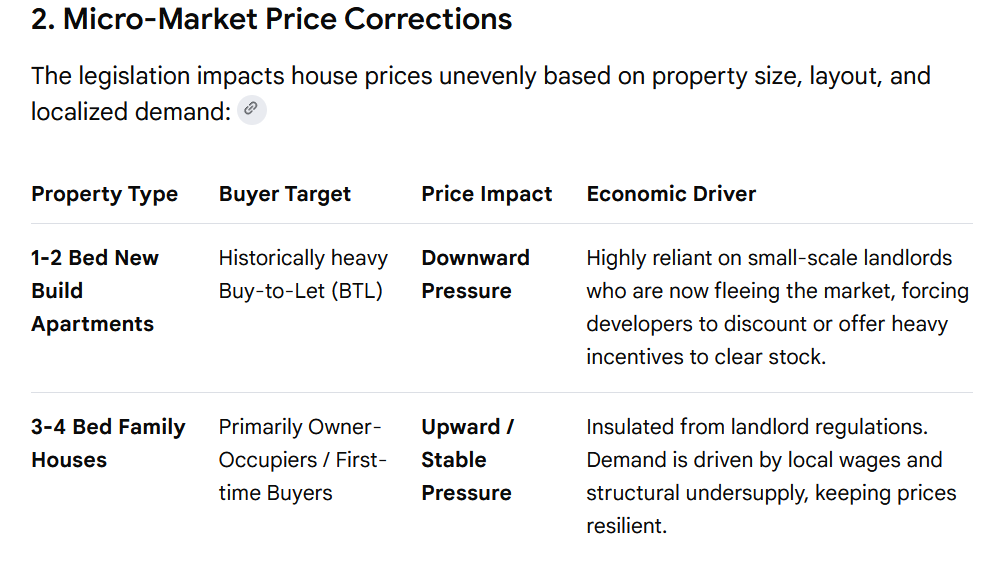
2. Micro-Market Price Corrections
The legislation impacts house prices unevenly based on property size, layout, and localized demand:
Property Type
Buyer Target Price
Impact
Economic Driver
1-2 Bed New Build Apartments
- Historically heavy Buy-to-Let (BTL)
Downward Pressure:
- Highly reliant on small-scale landlords who are now fleeing the market, forcing developers to discount or offer heavy incentives to clear
stock.
3-4 Bed Family Houses
- Primarily Owner-Occupiers / First-time Buyers
Upward / Stable Pressure: - Insulated from landlord regulations. Demand is driven by local wages and structural undersupply, keeping prices resilient.
3. Structural Shifts Influencing Value
The mechanics of the Section 21 ban reshape how new homes are built and priced:
Elimination of "Vacant Possession" Premiums: Previously, landlords bought new builds knowing they could easily clear out tenants via Section 21 to sell the asset unencumbered. Under the new rules, landlords must use Section 8 Ground 1A to sell, which bans evictions during the first 12 months of a tenancy and requires a longer 4-month notice period. This added friction lowers the capital value of properties currently tied to tenancies.
Developer Pivot to First-Time Buyers: Because developers cannot rely on speculative investor flipping, they are redesigning layouts. They are swapping investor-friendly flats for homes that qualify for alternative affordable routes, directly aligning prices with domestic purchasing power rather than landlord yields.
Diminished Rental Supply Cascades to Sales: As existing landlords sell off older properties to escape tighter regulations, overall rental supply shrinks. This keeps rental yields artificially high, making the remaining premium-priced new builds look highly attractive to institutional "Build-to-Rent" funds despite the strict legal framework.


Home
Secretary, Shabana
Mahmood, introduces rules to bar councils using luxury
homes for migrants.
The
United
Kingdom is one of the most corrupt countries, according to Transparency
International. We are concerned at the number of ground work
companies and housebuilders, that have become insolvent in 2026.
One
way of reducing the cost of houses, is for a subcontractor to carry out
the groundwork, and then declare bankruptcy. That leaves the developer a
way to reduce their costs. And, worryingly, there is nobody to sue if
the foul drainage, water, power, or other SuDs installation is below
standard.
LINKS
https://www.theguardian.com/business/2020/feb/27/persimmon-chief-to-step-down-despite-company-1bn-profit-dave-jenkinson
https://www.theguardian.com/business/2020/feb/27/persimmon-chief-to-step-down-despite-company-1bn-profit-dave-jenkinson
....
Please use our
A-Z INDEX to
read more